Quiet roads can trick you into missing trouble in your rear hubs. For a smooth 2026 ride, pick a rear hub assembly bearing that matches your drivetrain, lug pattern, and ABS sensor, because wheel bearing failures cause about 1% of vehicle crashes in the U.S., according to NHTSA.
Why rear hub assemblies matter for how your car feels
Your rear hubs carry the car’s weight and keep your wheels rolling straight. Even though they sit out of sight, they take constant hits from potholes, rain, heat, and road salt. A strong hub helps your car feel steady in turns and calm at highway speeds. A weak one can make the ride feel shaky or rough, and that stress can spread to tires and brakes.
A worn hub bearing often starts small, then grows into a bigger problem. You can run into a low hum that rises with speed. From there, you can get a louder growl, or a grinding sound that makes your stomach drop. Sometimes the rear end feels loose in curves, or the car seems to wander more than usual. You can also get uneven tire wear, since the wheel no longer stays perfectly aligned.
Because of this, braking can feel less smooth, and your ABS light can come on in some situations.
Heat and water are common causes. Hot bearings lose grease faster, and water can push past weak seals. Road salt also eats at metal surfaces, which speeds up wear. Impacts from curbs or deep potholes can damage the races, so the bearing never rolls clean again.
Fit comes before brand
Before you pick a hub, match it to your exact vehicle details. Drivetrain matters, because AWD, FWD, and RWD setups can use different hubs. Lug pattern also matters, since the wrong pattern means the wheel cannot mount right. ABS compatibility matters too, because the sensor needs a clean signal to keep traction and braking stable.
After all, a great hub on paper still fails your needs when the fit is off. In that case, you waste time and money, and the car still feels wrong.
Why the Detroit Axle and PAROD picks stand out
Now that fit is clear, materials and sealing are the next big deal. Detroit Axle and PAROD earn attention because they lean on tough steel, sealed builds, and heat-treated races. Seals keep grime and water out, which protects the grease and helps the bearing roll quietly. Heat-treated races resist scoring, so the hub stays smooth through long miles and rough weather.
Meanwhile, a solid seal also helps with noise control. It keeps the bearing from drying out and turning your calm drive into an annoying hum. That’s a small comfort that feels big on a long commute.
Next, you’ll see which one fits your car best.
| Detroit Axle Rear Wheel Bearing Hub Assembly (2-Pack) |
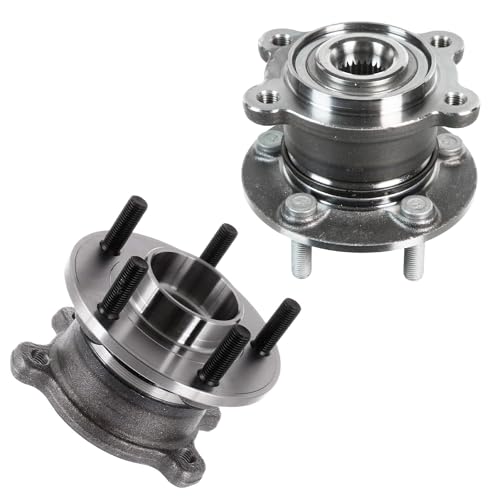
| Long-Warranty Pick | Vehicle fitment: 2013–2019 Ford Escape AWD; 2015–2019 Lincoln MKC AWD | Package quantity: 2-pack | Wheel position: Rear (left & right) | CHECK LATEST PRICE | Read Our Analysis |
| PAROD 513275 Wheel Bearing Hub Assembly Pair for Ford/Lincoln |

| Broad Fitment Choice | Vehicle fitment: Multi-fit Ford/Lincoln (Edge/Flex/Taurus/MKS/MKT/MKX, etc.) | Package quantity: Pair (2pcs) | Wheel position: Front/Rear (varies by application) | CHECK LATEST PRICE | Read Our Analysis |
| Detroit Axle Rear Wheel Hub Bearing Assembly (2pc) |

| Best Warranty | Vehicle fitment: Multi-fit Nissan/Infiniti (+ Mitsubishi RVR) (various years) | Package quantity: 2pc kit | Wheel position: Rear (left & right) | CHECK LATEST PRICE | Read Our Analysis |
| PAROD 512150 Rear Wheel Bearing Hub Assembly w/ABS |

| Best Value | Vehicle fitment: Multi-fit GM (Chevy/Buick/Pontiac/Saturn; various years) | Package quantity: Single assembly | Wheel position: Rear | CHECK LATEST PRICE | Read Our Analysis |
| PAROD Wheel Hub & Bearing Assembly for Ford Explorer |

| Non-ABS Option | Vehicle fitment: 2011–2019 Ford Explorer; 2013–2018 Police Interceptor Utility | Package quantity: 2pcs | Wheel position: Front/Rear (varies by application) | CHECK LATEST PRICE | Read Our Analysis |
More Details on Our Top Picks
Detroit Axle Rear Wheel Bearing Hub Assembly (2-Pack)
Should you drive a 2013 to 2019 Ford Escape AWD or a 2015 to 2019 Lincoln MKC AWD, the Detroit Axle Rear Wheel Bearing Hub Assembly 2-Pack is built for you, because it matches the rear left and rear right hubs you actually need, not a one size fits all guess. You get two rear hub assemblies, each with 5 lugs, ABS support, and a 4 bolt square flange. So your install stays straightforward. Detroit Axle also tests for impact, wear, and fatigue. That means you can trust it on rough roads. And the 10 year warranty helps you breathe easier.
- Vehicle fitment:2013–2019 Ford Escape AWD; 2015–2019 Lincoln MKC AWD
- Package quantity:2-pack
- Wheel position:Rear (left & right)
- Lug count:5 lug
- ABS provision:Yes (ABS)
- Warranty:10-year
- Additional Feature:Impact/wear/fatigue tested
- Additional Feature:4-bolt square flange
- Additional Feature:AWD-specific design
PAROD 513275 Wheel Bearing Hub Assembly Pair for Ford/Lincoln
Should your Ford or Lincoln starts to hum, wobble, or feel rough at highway speed, the PAROD 513275 wheel bearing hub assembly pair gives you a solid, confidence-restoring fix because it replaces both hubs as a matched set. You get steady hub rotation, strong support for the vehicle’s full weight, and a smoother, safer drive you can actually relax into.
Next, fit matters, so check your year, make, and model before you buy. It fits Edge, Flex, Taurus, MKX, MKS, and MKT, plus Police and Special Service Sedans. Finally, you’re covered with OEM quality materials, full testing, 3-year protection, and Amazon email support through MACEL.
- Vehicle fitment:Multi-fit Ford/Lincoln (Edge/Flex/Taurus/MKS/MKT/MKX, etc.)
- Package quantity:Pair (2pcs)
- Wheel position:Front/Rear (varies by application)
- Lug count:Not specified
- ABS provision:Not specified
- Warranty:3-year protection
- Additional Feature:OEM-quality replacement
- Additional Feature:Premium material build
- Additional Feature:100% reliability tested
Detroit Axle Rear Wheel Hub Bearing Assembly (2pc)
Detroit Axle’s Rear Wheel Hub Bearing Assembly (2pc) fits you best provided you want a confident, no-drama rear-end fix for a compatible Nissan or INFINITI, especially once that humming or grinding sound starts to make every drive feel tense. You get both rear left and right assemblies, so you won’t patch one side and worry about the other. Next, fitment stays clear: Altima 2007 to 2018, Maxima 2009 to 2019, Murano and Pathfinder except 4WD, plus JX35 and QX60 except 4WD, and RVR 2011. It uses a 5-lug, 4-bolt square flange, ABS encoder, and carries a 10-year warranty.
- Vehicle fitment:Multi-fit Nissan/Infiniti (+ Mitsubishi RVR) (various years)
- Package quantity:2pc kit
- Wheel position:Rear (left & right)
- Lug count:5 bolt
- ABS provision:Yes (ABS encoder)
- Warranty:10-year
- Additional Feature:Encoder ABS sensor
- Additional Feature:Impact/wear/fatigue tested
- Additional Feature:4-bolt square flange
PAROD 512150 Rear Wheel Bearing Hub Assembly w/ABS
PAROD 512150 rear wheel bearing and hub assembly with ABS fits you best in case you drive one of the listed FWD GM vehicles and in case you want a quiet, steady rear end again, without guessing games at install time. It matches 5 lug rear setups and works with ABS on models like Impala, Monte Carlo, Grand Prix, Regal, Lacrosse, and more, across many years.
Next, you’ll like how it’s built to OE specs and vehicle-tested for fit. It holds the tire securely, carries body weight, and guides smooth hub rotation. Plus, you get a 3-year warranty and responsive Amazon email support.
- Vehicle fitment:Multi-fit GM (Chevy/Buick/Pontiac/Saturn; various years)
- Package quantity:Single assembly
- Wheel position:Rear
- Lug count:5 lug
- ABS provision:Yes (w/ ABS)
- Warranty:3-year
- Additional Feature:FWD-specific design
- Additional Feature:Vehicle-tested fitment
- Additional Feature:OE-spec construction
PAROD Wheel Hub & Bearing Assembly for Ford Explorer
In case you drive a 2011 to 2019 Ford Explorer, or a 2013 to 2018 Ford Police Interceptor Utility, this 2-piece 512460 wheel hub and bearing assembly can feel like the “right fit” you’ve been hoping for, especially during the times you need a dependable replacement for a 5-lug non-ABS setup.
It’s built from high-quality materials that match original equipment standards, so you’re not gambling on feel or fit. Next, you’ll notice how it helps hold the tire steady, carry the vehicle’s weight, and guide smooth, precise rotation. Before you purchase, check Year, Make, and Model in the menu. You also receive a 3-year protection plan and Amazon email support.
- Vehicle fitment:2011–2019 Ford Explorer; 2013–2018 Police Interceptor Utility
- Package quantity:2pcs
- Wheel position:Front/Rear (varies by application)
- Lug count:5 lug
- ABS provision:Non-ABS
- Warranty:3-year protection plan
- Additional Feature:Non-ABS compatible
- Additional Feature:Vehicle-tested fitment
- Additional Feature:OE-quality materials
Factors to Consider When Choosing Rear Hub Assemblies Bearings
You want rear hub assemblies bearings that fit right the initial time, so you’ll start with exact vehicle fitment and then match your drivetrain and ABS type to avoid warning lights and weird brake feel. Next, you’ll check hub and flange specs like bolt pattern, spline count, sensor style, and offset, because even a small mismatch can turn an easy job into a long, frustrating one. Finally, you’ll lean on solid materials, clean machining, and real testing and certifications, so you can drive with quiet confidence instead of crossing your fingers at every bump.
Vehicle Fitment Accuracy
Because a rear hub assembly bearing has to line up perfectly with your car’s parts, vehicle fitment accuracy matters more than brand names or shiny coatings. Start through matching the exact make, model, and year, since small changes can alter mounting points. Next, confirm the wheel lug count and the flange type, so the wheel sits flush and torques down safely. Then check ABS sensor integration, because the hub must accept the same sensor style your system expects. Also verify the drive setup, in case your vehicle uses AWD, FWD, or 4WD, since the wrong design can bind or sit wrong. Finally, choose the correct rear left or rear right unit, because mirrored parts don’t always swap. When it fits right, you’ll feel calmer.
Drivetrain And ABS Type
While the hub assembly could look like a simple metal part, it has to match your drivetrain and ABS type with zero guesswork, or the whole rear wheel setup can feel wrong. In case you drive AWD, you’re asking the rear hubs to handle real torque and heavy loads. So you need an AWD-rated assembly built for that stress, often with an AWD-style flange pattern and lugs made for the job. Should you put a FWD-style hub back there, you can end up with noise, looseness, or premature wear.
Next, check ABS type, because the sensor system lives in the hub. In the event your car uses an encoder, you must buy a hub with the correct encoder, or ABS can misread speed and braking can feel scary.
Hub And Flange Specs
Fitment is the guardrail that keeps your rear wheel feeling steady and safe, and hub and flange specs sit right at the center of that. Start with lug count. In case your car needs a 5 lug hub, don’t “make it work,” because the wheel won’t seat right and that can feel scary fast.
Next, match the flange type to your axle and mounting points. A 4 bolt square flange, for example, only fits the setup it was made for. Then, look for the right ABS sensor style or encoder. In the event your vehicle uses ABS, the wrong signal can trigger lights and odd braking.
Finally, measure the hub and flange dimensions with care. Your drivetrain, like AWD or FWD, also locks in which design will truly fit.
Material And Build Quality
During the moment you’re selecting a rear hub assembly bearing, material and build quality decide whether your wheel stays calm and steady or starts to feel rough and uncertain. You want tough, high grade steel and heat treated races that resist impact, wear, and fatigue, so the bearing doesn’t give up prematurely. Also look for smooth machining, tight seals, and clean finishes, because these details help the hub rotate precisely under the full weight of your vehicle.
Next, focus on how closely it matches original equipment specs. At the point the bearing meets or beats OEM sizing and tolerances, it fits right, stays quiet, and avoids wobble. Choose solid construction with corrosion resistant coatings, so road salt, water, and grime don’t sneak in and shorten its life.
Testing And Certifications
Because your rear hub bearing holds up your wheel every mile you drive, you should pay close attention to its testing and certifications prior to you buy. You deserve parts that won’t quit once the road gets rough.
Start with looking for proof of impact, wear, and fatigue testing. These trials show the hub can handle potholes, heat, and long miles without loosening up. Next, check for certification rules that demand 100% reliability testing, so every unit gets verified, not just a few samples. You also want tests for proper fit, smooth rotation, and true load capacity, because your vehicle’s weight rides on this. Finally, choose OEM equivalent or trusted aftermarket hubs that meet industry benchmarks for material strength and long life, so you drive with calm confidence.
Warranty And Support Coverage
Testing and certifications can show a rear hub assembly is built to last, but your warranty and support coverage tell you what happens should it doesn’t. Warranty length can run from about 3 to 10 years, and that time matters whenever you’re counting on safe, quiet driving. Often, a longer warranty means the maker trusts its bearing to hold up.
Next, look past the years and check the help you’ll get. Good coverage supports you with fit questions, install mistakes, parts swaps, and defects in materials or workmanship. Also, responsive email or phone support keeps a claim from turning into a weekend headache. Before you buy, read the fine print for wear exclusions and required maintenance rules too.